Heritage
'...generation to come would know, the children yet to be born, That they would arise and tell them to their children, So that they would put their confidence in God' Psalm 78:6-7

When I was born, my parents were not yet believers. I came into this world in the penultimate year of the Soviet Union, where atheism was the dominant “religion.” I don’t know if they ever pondered questions about the nature of existence. However, as a child, I was often sick, and I know this prompted my mother to seek help from Someone she did not yet know. The thought that there might be something greater began to stir in her heart because of me.
In the early 1990s, as the great atheist empire collapsed, believers from all over the world began to come into a land where no one knew God. I am deeply grateful to all those people who traveled to the countries of the former Soviet Union. Would I want to be a missionary to North Korea if its regime were to fall? Yes, absolutely. That’s why I understand and admire those missionaries so much—especially in those days when there was no internet, no easy way to call home. A letter with a simple question or news could take a month or more to reach their families, and another month for a reply to come back.
But this is the part about children. My family searched for God for years, changing congregations along the way. I belong to the first generation of children born to believing parents in my country. In many regions of Ukraine, there are children today who are or will become the first generation born to Christian parents.
In my school of over 1,000 students, when I graduated there were exactly 1,032. Among all Christian denominations combined, there were only five children whose parents attended church regularly and lived as faithful believers. In my early teens, I knew almost every child of believing parents among the Churches of Christ, and they weren’t in the hundreds—they were only a few dozen. I remember attending a single youth camp where we all met for the first time. It felt miraculous.
But I also want to speak of the tremendous social pressure. This pressure will continue for many generations, especially in Europe.
There’s a part where the Bible is silent, but it’s clear if you think about it: among those baptized by John, among those who listened to Jesus, among those who were persecuted and killed during the apostles’ lifetimes, among Christians enduring famine in Judea and receiving aid, and among those fleeing Jerusalem before its destruction—there were children. There were children of Christians whose parents were burned as torches, children of Christians whose parents were devoured by lions, and children of Christians who were crucified and tortured.
Likewise, there were parents who watched as these same horrors were inflicted on their children. Every hero in the Bible is someone’s child.
In the territories of Ukraine occupied by Russia, there is no religious freedom. This makes the chilling words of Jesus resonate more deeply:
“Now brother will betray brother to death, and a father his child; and children will rise up against parents and cause them to be put to death.”
(Matthew 10:21)
“For I came to turn a man against his father, and a daughter against her mother, and a daughter-in-law against her mother-in-law; and a person’s enemies will be the members of his household. The one who loves father or mother more than Me is not worthy of Me; and the one who loves son or daughter more than Me is not worthy of Me. And the one who does not take his cross and follow after Me is not worthy of Me.”
(Matthew 10:35-38)
In today’s world, this often means simply holding different beliefs than your relatives—not facing death, persecution, or being forced to flee your home.
The great war in our country has raised a pressing question: Who will be in our churches after us? An enormous number of people, including Christians, have emigrated. Many others, including Christians, have been killed. Meanwhile, there is an overwhelming number of people here who have never heard about God—children who have never heard the name of Jesus.
This long war is making people weary, and weary people often become cynical and cruel. In Ukraine today, we see both: many people are coming to God, and many are turning away because of the evil and injustice they witness all around them.
Do you remember the story Jesus told in Luke 18:1–8 about the widow who sought justice? He told it so that we would “always pray and not lose heart.” Not to lose heart in God. Not to give up on prayer, even when you continue to face injustice for a long time. That story ends with Jesus’ words:
“However, when the Son of Man comes, will He find faith on the earth?”
(Luke 18:8)
What kind of generation will be shaped by children growing up in a world full of injustice—surrounded even by believing adults who are beginning to lose faith in the power of prayer?
In Western Europe today, the spiritually strongest churches are often those filled with migrants from Africa, India, and other countries where previous generations of Christians sowed the seed of the gospel.
Growing up alongside the first generation of believers in my country, I witnessed their courage. I saw them going into orphanages—places no one had visited before them. I saw examples of adoption. Before the full-scale invasion, my father taught the Bible in the orphanage in his city as part of his ministry.
From my teenage years, I and other Christian teens fought for every other young soul we could reach. As we grew older, we began visiting rehabilitation centers for children battling addictions. For years, we partnered with Eastern European Mission to run camps for orphans—doing our best to sow seeds of faith. In some cases, those seeds took root.
I married my best friend, the most faithful servant I know. She came to Christ through a ministry in her school and a camp called Amerikraine, which we now help organize. We were both 22 when we married and moved to serve in a new congregation in another region of the country. Two years later, war broke out.
For years, we provided shelter in our tiny one-room apartment for younger Christians from our congregation or nearby churches. In 2015, we planted our first church to minister more effectively to refugees, teens, and children. Our small apartment was always full of people, and this allowed us to build deep relationships with them.
In one congregation where we regularly preached alongside other families, we took in two young girls at the end of their teenage years. They became like younger sisters to us. They graduated from our care, married faithful Christian men, and now live abroad.
God did not give us biological children, and we accepted that with peace. The war that began in 2014 shaped our context. We understood what Jeremiah meant when he wrote:
“For this is what the Lord says concerning the sons and daughters born in this place, and concerning their mothers who give birth to them, and their fathers who father them in this land: ‘They will die of deadly diseases, they will not be mourned or buried; they will be like dung on the surface of the ground. And they will perish by sword and famine, and their dead bodies will become food for the birds of the sky and for the animals of the earth.’”
(Jeremiah 16:3-4)
And we heard Jesus’ words:
“Daughters of Jerusalem, stop weeping for Me, but weep for yourselves and for your children. For behold, days are coming when they will say, ‘Blessed are those who cannot bear, and the wombs that have not given birth, and the breasts that have not nursed.’”
(Luke 23:28-29)
“But this I say, brothers: the time has been shortened, so that from now on those who have wives should be as though they had none; and those who weep, as though they did not weep; and those who rejoice, as though they did not rejoice; and those who buy, as though they did not possess; and those who use the world, as though they did not make full use of it; for the present form of this world is passing away.”
(1 Corinthians 7:29-31)
A particularly significant story for us came at the beginning of the war. There was a boy we took into our home. His brother had been killed in a shelling attack, and shortly afterward, his father died of a heart attack. He was still a schoolboy with several years of study ahead of him. For us, this became a season of taking responsibility for a child who was not biologically ours.
He began working in his teenage years as a kitchen assistant in a local restaurant. Just a few days before the full-scale invasion, we sent him off from our home. Today, he is married to a wonderful Christian woman, has a child of his own, and remains faithful to God. We are so proud of him. Since he came from a loving family, the relationship we built with him was more like that of older brother and younger brother.
My biological younger brother also came to live with us for several years because of the war. He arrived to work his first job and stayed with us through much of that time. At the time of the full-scale invasion, we had just sent him off from our home as well. Today he is married, has a child, and lives in another part of Ukraine. We are proud of him too.
In 2015, we not only planted a church but also started a small educational center for children, teaching them English for free through Bible lessons. Among the children who came to us were a brother and sister—she was 13, and he was 12. The following year, they lost their mother to cancer, a diagnosis they hadn’t even known about.
Their father, a former soldier, carried all the scars and struggles of those who had fought in Afghanistan—soldiers sent to a war they should never have been in, for causes that should never have existed. Their home was not a safe place for them. They had a grandmother, but during that time, she became bedridden. We witnessed this transition, and later she, too, passed away.
While they were caring for their grandmother as children, they continued attending our lessons, and we began letting them stay with us more often. After her death, and because of the danger in their home, we took them in fully. We never formalized any legal documents. We received no government support, no benefits. We simply raised them as our own children.
Today, our son still lives with us, and our daughter has completed her first year at Faulkner University in the United States. Because of the war, we had to send her away for her safety. She made the President’s List for her academic excellence. She knows God’s Word profoundly, and I am confident she will raise faithful Christian children. Our son, I believe, will one day make an excellent deacon for the church.
During the war, we also had to part ways with another boy whose family was scattered across the country. His father went missing during the war, and his mother struggled deeply—not just with life but with her faith in God as well. He met us at the time of the full-scale invasion and even lived with us for the first year of the new church we planted in 2023. Because of safety concerns, he later moved to another part of Ukraine. Today he is serving faithfully in his local church, teaching others, and sharing God’s Word.
In 2024, a younger brother joined our family—a Christian orphan who had been baptized at a Christian camp. He planned to attend university after finishing school, but the institution was destroyed by Russian missile strikes. He comes from a small town constantly under bombardment. Today, you can always ask him to lead a prayer. He is a future evangelist. He would have been our son, but he has an aunt who raised him and became like a mother to him, so we never tried to replace that role.
Also in 2024, we welcomed a new “daughter” into our lives. She was baptized in January and is now preparing to apply for university. She has a beautiful gift for working with children, and I am confident she will become an incredible blessing to God’s church in the future.
We have all survived a fire. We still lack many basic things—furniture, clothes—and there are many dental needs for the children we still need to address. Yet everything we have is carefully balanced between serving more and merely living. If we focused on rebuilding ourselves, we would not be able to serve or help others.
The verse from Haggai 1:4 resonates deeply with us:
“Is it time for you yourselves to dwell in your paneled houses while this house lies desolate?”
We cannot change things globally. We do not know if we will survive this war. But I believe that each of us can change at least one life if we are willing to make the effort.
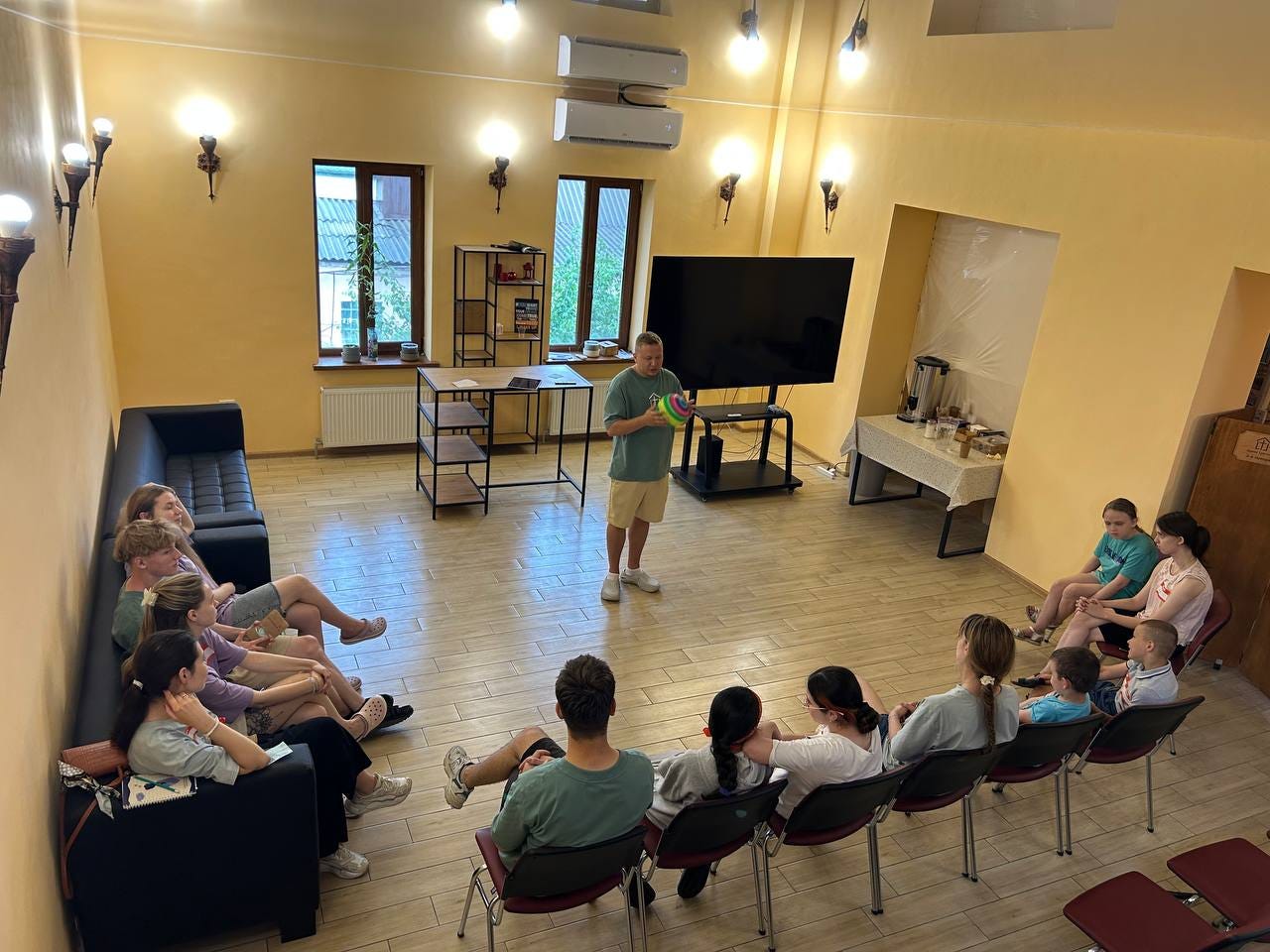
In June, shelling began even during the daytime in our area. It became extremely difficult for adults to gather, and of course, no one wanted to send their children out when it was dangerous just to walk the streets. And yet, we still held a small Summer Bible School. It was very modest, but in a context where finding children willing to come to a church building in a city where it can be dangerous even in daylight is a victory, we rejoice that God gave us this opportunity.
I am deeply thankful for everyone through whom God is working, so that He might also work through us. Thank you for your hearts.
And no, we do not have many resources. Fuel for the car to help refugees often consumes a third—or on good months, a quarter—of everything we have for the month. Everyone who is able to work or take on odd jobs during the war does so. It is not enough. But despite this, our God is great and continues to do so much good, showing mercy and kindness.
“Shall we indeed accept good from God but not accept adversity?”
(Job 2:10)
I hope this message might encourage someone to remember that serving God requires priorities, not resources. And I deeply hope that not only your church, but also you personally are thinking about who will replace you in glorifying God and serving Him in the future.
I do not know how many Christians there will be in my country in the years to come, but I pray that God will bless my wife and me so that among those who will preach in the future will be some in whom we sowed and watered.
Pray for us as well. Things are difficult right now, and we have not fully recovered from the impact of the war. But pray that there may be as many Christians as possible.
P.S. In a perfect world—one in full harmony with God, without sin or death—the command to “be fruitful, multiply, and fill the earth” (Genesis 1:28) was not merely about physical reproduction. It was about cultivating and nurturing souls who would be without sin, created for eternal life with their Creator.
I believe we can trace this thought even in the story of Noah. After the world was cleansed of its corruption by the flood, God repeated this command to Noah and his family: “Be fruitful and multiply, and fill the earth” (Genesis 9:1). This, too, carried a deeper meaning than just rebuilding a physical population. It pointed to a renewal of humanity, a call to raise generations who would walk in righteousness and covenant relationship with God.
These stories are not only about the physical act of bringing children into the world; they are also about the spiritual calling to cultivate lives dedicated to God. Even today, as we consider the children entrusted to us—biological or spiritual—this calling remains. We are invited to plant seeds of faith, to water them, and to nurture growth in a way that echoes God’s original design for life without sin and death.